Key Takeaways
- Scan-based progress monitoring provides objective, field-verified visibility into construction progress by comparing recurring reality capture data against project models, schedules, and milestones.
- Semiconductor construction teams use scan-based progress monitoring to validate installation readiness, monitor planned-versus-actual performance, and identify issues before they disrupt tool installation or commissioning.
- Unlike visual reporting alone, scan-based progress monitoring verifies whether installed work is spatially accurate, coordinated, and completed to the standard required for the next phase of construction.
The Visibility Gap in Semiconductor Project Delivery
Semiconductor fab construction leaves little room for uncertainty. Programs are delivered against compressed schedules, dense utility coordination, strict tolerances, and milestones tied to cleanroom readiness, tool installation, commissioning, and the path to production. A delay in one area quickly cascades across trades, installation sequences, and downstream activities.
Despite this complexity, many project teams still rely on manual updates, visual walkthroughs, and subjective percent-complete reporting to understand whether work is advancing as planned. These methods are useful, but they provide an incomplete picture. Progress can appear satisfactory at a high level while hidden installation issues, incomplete interfaces, or unverified field conditions create risk beneath the surface.
Scan-based progress monitoring connects reported progress to what has actually been installed. By capturing recurring point cloud data and comparing current conditions against project models, schedule activities, and defined milestones, owners and delivery teams can see where progress is aligned, where it is falling behind, and where emerging issues could affect the broader program.
The value of scan-based progress is not a better visualization of the site. It is greater confidence in decisions about schedule, coordination, earned value, and installation readiness.
The Limitations of Traditional Progress Reporting
Construction progress is typically communicated through contractor updates, photographs, site observations, and estimated completion percentages. Each depends on interpretation.
Consider how a walkthrough may confirm that equipment is present or utility systems are in place. However, it will not always verify whether installed work is complete, coordinated, or positioned correctly. Likewise, a visual snapshot documents activity but offers limited spatial context. And a reported percentage often reflects effort expended, rather than measurable installed scope. These limitations matter more in semiconductor environments, where progress is not defined only by whether something has been installed.
Teams need to know whether it is in the correct position, aligned with the coordinated model, ready at its interfaces and tie-ins, within tolerance, and able to support the next scheduled milestone. A utility rack may appear substantially complete but contain an unresolved conflict, such as a routing clash with adjacent systems or an unfinished tie-in, that blocks follow-on work. Similarly, a tool area may look ready but have datum, clearance, or hook-up issues.
Without field-verified information, these problems often stay hidden until they begin affecting downstream activities.
Turning Point Clouds Into Project Intelligence
A point cloud alone does not provide schedule confidence. The value comes from connecting captured reality to the project controls that guide delivery. A scan-based progress monitoring workflow typically involves:
- Establishing a reliable survey control framework
- Capturing site conditions at an agreed cadence or around critical milestones
- Registering each capture against the project coordinate system
- Comparing installed conditions with building information modeling, design models, or verified baselines
- Linking measurable scope to schedule activities, zones, and work packages
- Identifying planned-versus-actual schedule and cost variance and reporting it in a format that supports timely action
This workflow turns reality capture from a periodic documentation exercise into a repeatable project management process. Instead of reviewing isolated images or generalized progress statements, teams examine field evidence tied to the same systems, areas, schedule activities, and milestones used to manage the program.
Why Fabs Require a Different Level of Visibility
Semiconductor construction concentrates highly coordinated systems in tightly controlled spaces. Cleanrooms, subfabs, utility corridors, process systems, electrical infrastructure, and automated material handling systems (AMHS) must come together within defined tolerances and sequences, so progress in one area is rarely isolated.
Delayed overhead utilities affect cleanroom completion and tool hook-up. Incomplete subfab systems prevent equipment installation. Supports installed out of position can force downstream trades to adjust, reroute, or rework connected systems. Frequent design changes and undocumented field changes can further complicate sequencing, model alignment, tool moves, and utility reroutes.
Fab owners, construction managers, and delivery teams therefore need more than a broad sense that construction is moving forward. They need to know that the right work is complete, in the right place, at the right time, and to the standard required for the next activity.
Recurring scanning helps surface these issues earlier, including installed work that does not match the coordinated model, zones progressing more slowly than their surroundings, systems reported as complete but not ready for follow-on trades, and work installed outside tolerance. A delay discovered in a coordination meeting is usually recoverable. The same delay discovered during tool move-in or installation has far greater consequences for labor, sequencing, and the path to production.
Note that scan-based project monitoring does not replace the judgment of project managers or field teams. Instead, it gives them better evidence, so progress discussions move quickly from debating the status of the work to deciding what happens next, helping protect critical schedule milestones.
Supporting Tool Move-In and Installation Readiness
Tool installation is one of the most schedule-sensitive stages of fab delivery. By the time equipment is ready to move into position, the surrounding environment must support move-in, installation, connection, qualification, and commissioning. Small discrepancies in location, elevation, or interfaces can cause significant disruption.
Scan-based workflows validate equipment and support locations, tool datums, hook-up interfaces, AMHS alignment and clearances, floor conditions, and completion of prerequisite work. Rather than relying on visual confirmation or general completion statements, teams can verify that physical conditions match the requirements of the installation plan.
The Importance of Survey Control and Geospatial Governance
Not every reality capture workflow provides the same confidence. For progress information to support high-stakes decisions, the data must be accurate, consistently registered, and managed within an agreed framework covering survey control, measurement tolerances, capture standards, version control, quality assurance requirements, data ownership, and reporting responsibilities. Without this foundation, teams risk comparing inconsistent captures against outdated models or making schedule decisions from data that was never intended to support that level of precision. With it, each capture contributes to a trusted digital record of the program rather than a standalone dataset.
A trusted, survey-controlled foundation is what separates verification from visualization. While a camera-based or AI-supported platform can show that activity has occurred, a survey-controlled, scan-based workflow can determine whether installed work is spatially correct and aligned with the project baseline. For semiconductor programs, that distinction is the difference between knowing something was installed and knowing it was installed correctly, within tolerance, and in time for the next scheduled activity.
From Reporting Progress to Schedule Confidence
Recurring captures create value beyond the active construction phase. They contribute to a field-verified digital thread supporting as-built models, digital twins, future tool moves, utility reroutes, retrofits, and expansions around live production. The result is a digital baseline that continues to support decisions after construction is complete.
The goal of scan-based progress monitoring is to strengthen established project controls or field expertise with objective, measurable evidence. For semiconductor owners and delivery teams, that means earlier identification of schedule risk, less ambiguity in reporting, reduced exposure to avoidable rework, and greater confidence in installation readiness.
Fab program managers already know that work is happening. True schedule confidence comes from knowing the right work has been completed correctly, in the right location, and in time for what comes next.
Key Takeaways
- Advanced manufacturing facility schedule acceleration is no longer defined solely by speed. Competitive success depends on the ability to meet aggressive delivery commitments with predictable outcomes.
- Schedule delays often stem from design complexity, system interdependencies, information gaps, permitting challenges, infrastructure constraints, and other risks that cannot be effectively managed through traditional sequential delivery methods.
- Owners can accelerate project delivery and reduce schedule risk by implementing six proven strategies: parallel design workstreams, rolling design and permitting packages, high-risk task force teams, parallel infrastructure planning, front-loaded permitting and stakeholder engagement, and a single source of truth for project decision-making.
- The most successful projects recognize a fundamental truth: speed is not created during construction. It is engineered into the project from the very beginning.
Schedule Is the New Currency
For advanced manufacturing companies, speed-to-production has become a strategic differentiator. Every month that a new facility is delayed represents a month of unrealized revenue, lost production capacity, diminished market share, and idle capital. In industries where customer demand, supply chain dynamics, and competitive pressures evolve rapidly, the ability to bring facilities online faster can directly influence business performance.
The reality is that competitive advantage increasingly depends not on the ability to build complex facilities, but on the ability to reliably orchestrate interconnected systems, stakeholders, and workstreams to meet aggressive delivery commitments with predictable outcomes. Speed is not something that only happens during construction. Speed is designed into a project from the beginning.
Where Schedule Risk Actually Comes From
Modern advanced manufacturing facilities contain intricate system interdependencies that cannot be effectively managed through traditional design processes. Process systems, specialized equipment, structural supports, electrical infrastructure, fire protection networks, automation systems, and operational requirements all compete for space inside highly constrained environments. A seemingly minor design adjustment in one discipline can create cascading impacts across multiple systems.
Compounding this challenge is that not every project faces the same scheduling risks. Some programs are constrained primarily by design complexity. Others are affected more heavily by utility infrastructure requirements, permitting and environmental reviews, specialty equipment procurement, construction sequencing, or brownfield renovation challenges.
Many schedule disruptions stem from information gaps discovered too late. Existing facilities may not match record drawings. Utility capacities may prove insufficient. Site conditions may differ from assumptions made during planning. In other cases, critical decisions remain unresolved long enough to create uncertainty throughout the project team.
The fundamental challenge is not the complexity of any single issue. It involves managing dozens of interconnected risks simultaneously while maintaining momentum across the entire program. Effective schedule acceleration begins by identifying and addressing those risks early, when solutions are faster, less expensive, and significantly less disruptive.
Six Levers to De-Risk Project Schedules
Successfully accelerating advanced manufacturing projects requires more than schedule compression. It requires a structured framework designed around the project’s specific risk profile. The following six strategies have consistently proven effective in supporting advanced manufacturing facility schedule acceleration across complex industrial and manufacturing programs.
1. Parallel Design Workstreams
Traditional project delivery often follows a sequential process in which individual disciplines have designed their components one step at a time, completing one aspect of the project before moving to the next. While familiar, this approach creates bottlenecks and limits the overall speed of design development.
A more effective strategy to achieve schedule acceleration is to divide projects into logical work packages across architecture, civil, structural, mechanical, electrical, plumbing, process, and specialty systems. Multiple teams in each discipline can then advance simultaneously while maintaining coordination through centralized building information modeling (BIM) management and project controls.
This approach delivers several advantages:
- Reduced dependency bottlenecks between disciplines
- Faster issue resolution and decision-making
- Accelerated permit package development
- Improved resource utilization
- Shorter overall design durations
For large manufacturing facilities involving dozens of technical disciplines, parallel execution allows work to progress continuously rather than waiting for sequential handoffs. Coordinated BIM environments serve as the foundation for maintaining design quality while enabling multiple teams to move forward concurrently.
2. Rolling Design and Permitting Packages
Many projects continue to follow a traditional model in which design reaches near completion before permit applications are submitted. This creates unnecessary schedule risk by delaying approvals and preventing construction activities from starting sooner.
Rolling design and permitting strategies break this cycle. Rather than waiting for a complete design package, project teams prioritize long-lead and critical-path components early in the process. Site development, foundations, utility infrastructure, structural systems, and other critical elements are advanced into phased permit packages aligned with construction priorities.
The benefits include:
- Earlier construction mobilization
- Faster procurement of long-lead equipment
- Reduced schedule compression during later project phases
- Increased schedule float
- Improved flexibility to manage evolving project requirements
- Accelerated project delivery
By allowing critical workstreams to begin while design continues in parallel, owners effectively gain time without sacrificing quality or compliance.
3. High-Risk Task Force Teams
One of the most effective schedule management techniques for complex industrial projects is the early identification of high-risk issues.
Common examples include:
- High-capacity utility infrastructure
- Specialized fire protection systems
- Environmental permitting requirements
- Process equipment integration
- Large process piping systems
- Structural support requirements
Rather than allowing these issues to compete for attention across the broader project team, dedicated task force teams can be established during project planning. These specialized groups focus exclusively on resolving schedule-sensitive challenges while the primary design team continues advancing the broader program.
The result is faster risk mitigation, fewer disruptions, and substantially less downstream rework. By confronting major risks early, project teams prevent a small number of complex issues from becoming schedule-critical obstacles later.
4. Run Infrastructure in Parallel
On many advanced manufacturing programs, power, water, and site civil infrastructure, rather than the building itself, represent the critical path.
Utility interconnections, substation upgrades, capacity expansions, and supporting site infrastructure frequently require longer timelines than vertical construction activities. Yet these workstreams are often initiated only after facility design has reached maturity.
Organizations that consistently deliver projects faster treat infrastructure planning as a parallel effort rather than a sequential activity.
Interconnection studies, utility coordination, civil engineering, permitting, and infrastructure assessments should begin alongside facility design. This approach exposes risks earlier and provides more flexibility to address them before they impact construction.
The objective is straightforward: when the facility is ready for operation, the supporting infrastructure is ready as well.
5. Front-Load Permitting and Stakeholder Engagement
Permitting and entitlement processes can quietly consume more schedule than any technical activity on a project.
The timeline is heavily influenced by preparation. Agencies review applications faster when documentation is complete, accurate, and supported by rigorous technical analysis. Similarly, communities and stakeholders respond more positively when engagement begins early rather than after major decisions have already been made.
Successful project teams front-load permitting efforts by investing in:
- Comprehensive survey and geospatial data collection
- Environmental assessments
- Civil engineering documentation
- Early agency coordination
- Stakeholder outreach programs
This proactive approach transforms permitting from an unpredictable obstacle into a manageable workstream that supports schedule certainty with measurable milestones and schedule accountability.
6. Make Decisions with a Single Source of Truth
This may be the single most important lever of the six. Complex programs rarely stall because teams are working slowly. More often, they stall because decision-making slows down.
When owners, engineers, architects, contractors, and suppliers operate from different information sources, every question requires reconciliation before action can occur. The resulting delays accumulate throughout the project lifecycle.
Digital delivery environments eliminate much of this friction.
Coordinated BIM models, shared data environments, integrated project controls, and geospatial management systems create a common operating picture for all participants. Teams work from the same verified data, allowing decisions to be made quickly and confidently.
This digital thread becomes even more powerful when combined with reality capture technologies, scan-to-BIM workflows, and geospatial control networks that connect planning, design, construction, and commissioning activities.
Field-captured data can be integrated into dashboards and project analytics platforms that provide near-real-time visibility into project performance and emerging risks. Examples include:
- Schedule performance
- Construction progress
- Quality metrics
- Comparisons between constructed conditions and design intent
- Clash detection before components are constructed
Instead of discovering problems weeks later, project teams identify and address them while corrective actions remain inexpensive and effective.
What This Looks Like in Practice
Consider a complex advanced manufacturing expansion involving both new facility construction and renovation of existing production space.
Under a conventional delivery model, teams might first complete site selection, then design the facility, then pursue permitting, and finally begin construction. Each phase would usually occur after the previous one had been completed.
A schedule-focused delivery strategy looks very different. Reality capture and scan-to-BIM efforts begin immediately, providing accurate existing-condition information from the start. Geospatial control networks establish a single source of truth that supports design, construction, and commissioning activities. Utility coordination and permitting workstreams proceed in parallel with concept design, while rolling permit packages accelerate approvals for critical-path activities.
Integrated architecture, engineering, and geospatial teams maintain a coordinated BIM environment throughout the project lifecycle. Construction progress is continuously validated through field capture technologies and digital reporting tools, allowing leadership teams to monitor performance and identify emerging risks in near real time.
The result is not the elimination of problems but a more predictable path to advanced manufacturing facility delivery.
Every complex project will encounter challenges. The difference is that issues are discovered earlier, when they cost days rather than months and thousands rather than millions of dollars. Construction inherits certainty instead of uncertainty, allowing teams to maintain aggressive schedules with greater confidence and predictability.
Speed Is Designed, Not Built
Achieving unconventional design and construction schedules for advanced manufacturing facilities requires more than accelerated execution. It requires a deliberate strategy that aligns planning, design, permitting, infrastructure, construction, and stakeholder engagement around schedule certainty from day one.
Every project presents a unique combination of risks and constraints. The most successful programs are those that identify these challenges early and implement a customized combination of schedule acceleration strategies to address them.
Owners willing to invest in proven approaches — including parallel design workstreams, rolling permit packages, high-risk task forces, advanced BIM coordination, geospatial intelligence, scan-to-BIM technologies, and digital delivery platforms — can achieve levels of advanced manufacturing facility schedule acceleration previously considered unattainable. Equally important, they can do so while reducing risk, improving cost predictability, and maintaining quality throughout the project lifecycle.
In today’s advanced manufacturing environment, competitive success increasingly depends on the ability to make aggressive commitments and deliver on them with confidence. The organizations that consistently outperform their peers understand a fundamental truth: speed is not created in the field. It is engineered into the project from the very beginning.
Behind every swipe, tap, and click, from streaming Bluey on a Saturday morning to AI-assisted remote surgery connecting a specialist in Singapore to a patient in regional Queensland, data centres are quietly powering the systems we rely on every day.
Although Asia–Pacific data centres are increasingly becoming part of the public conversation, they are often misunderstood. Beyond the headlines, they underpin real-time services, digital economies, and the infrastructure required to support a rapidly digitising region. They enable us to connect, learn, work, and access critical services, forming the backbone of a more connected and resilient society. As digital demand accelerates, so too does the importance of getting this infrastructure right.
Asia–Pacific Data Centres: A Defining Growth Market
Despite the U.S. and Europe leading in terms of gigawatts of data centre capacity, the Asia–Pacific data centre market is now one of the fastest‑growing globally. Investment is projected to exceed $58 billion by 2027, with capacity expected to grow by more than 60% by 2030.
According to a KPMG report, mature markets with established digital infrastructure include Hong Kong, Singapore, Seoul, Tokyo, Beijing and Shanghai, while emerging markets such as Thailand, India, Indonesia, and the Philippines are viewed as having significant growth potential.
The drivers behind Asia–Pacific‘s immersive growth are structural and sustained: rising digital consumption, widespread cloud adoption, the rapid expansion of AI workloads, and increasing government focus on data sovereignty and localised infrastructure. This is not a short-term cycle, but a fundamental shift in how economies are built and supported.

Source: Moody’s (2025) APAC data centres: Dispersed growth, unique challenges
Australia’s Role in Regional Expansion
Australia sits at the centre of this transformation. Sydney and Melbourne are already among the world’s leading data centre markets, with demand continuing to outpace supply. Together, these cities serve as the primary engines of Australia’s digital economy and AI infrastructure, with Sydney alone home to more than 100 data centres.
Greenbox, a Woolpert Company, has delivered several of Sydney’s most recognisable data centres. These distinctive facilities, with their eye‑catching façades and considered architectural design, represent a new breed of data centres for urbanised environments that are both functional and aesthetically pleasing.
The secret to Australia’s data centre growth lies in its stable regulatory environment, strong connectivity, skilled workforce, and growing access to renewable energy. These factors position the country as one of the most attractive locations for large-scale Asia–Pacific data centre investment.
At the same time, evolving data sovereignty requirements across Asia–Pacific are accelerating the need for localised infrastructure, reinforcing Australia’s role as both a destination and a gateway. The infrastructure being built today will shape how Australians experience education, healthcare, commerce, and connection in the years ahead.
A Region of Distinct Markets
Beyond Australia, growth across Asia–Pacific is both significant and diverse.
Singapore remains a highly mature market, where land and power constraints are driving new approaches to efficiency and design. In 2023, the country began development of a 700 MW low-carbon data centre park in Jurong Island. Keeping with Singapore’s sustainability goals, this site will use hydrogen-ready plants, expanded battery storage, ammonia power, and solar.
Japan is also seeing renewed momentum through AI investment and government-led digital transformation. Currently, Japan is the second-largest data centre market among developed nations after the U.S., with projections to reach USD $33.4 billion by 2030.
India is rapidly scaling, with major hubs such as Mumbai, Chennai, and Hyderabad expanding at pace. Meanwhile, Southeast Asian markets including Malaysia, Indonesia, and Thailand are attracting hyperscale investment as demand for low-latency services increases.
Asia–Pacific is not one market, but a collection of distinct environments, each shaped by its own regulatory frameworks, energy constraints, and development pathways. Navigating this complexity requires deep local insight combined with the ability to deliver consistently across regions.
As these markets scale, the success of future Asia–Pacific data centres will increasingly depend on early-stage decisions, from site selection and power strategy through to planning pathways and long-term integration with surrounding communities.
Economic and Community Impact of Data Centres
The growth of Asia–Pacific data centres is creating a new generation of roles across engineering, digital infrastructure, and environmental design. These are not extensions of traditional industries, but entirely new career pathways aligned to how economies are evolving across the region.
For communities, the impact is equally significant. Data centres enable faster, more reliable services and support systems that improve how people live and work. From real-time language translation across diverse regions, to telemedicine connecting remote communities to major urban centres, the outcomes are practical, immediate, and growing. Every one of these possibilities depends on reliable, well-planned digital infrastructure.
Toward Integrated, Sustainable Systems
With data centres critical to Australia and Asia–Pacific’s economic future, ensuring a consistent and reliable power supply will be a top priority. To avoid grid bottlenecks, many regions are increasing the role of renewable energy and battery storage systems within their energy mix.
New energy innovations, such as hydrogen fuel cells and advanced solar panels, are being deployed through clean energy sourcing strategies, including clustering data centres near high‑quality solar and wind resources. At the same time, new design approaches are reducing water use and improving operational efficiency. Together, these efforts will boost electricity supply, strengthen reliability, and accelerate the Asia–Pacific region’s clean energy transition.
There is also growing momentum around integrated systems, where data centres contribute directly to surrounding industries and communities. Whether through energy reuse, shared infrastructure, or smarter planning, these approaches are moving from concept to reality.
The Possibilities Are Only Growing
So next time you stream a show, check a weather app, get a real-time traffic update, or join a video call with a colleague in another country, remember there is a data centre behind it, discreetly making it all happen.
At Woolpert, we see data centres as more than just infrastructure. They are critical systems that enable connection, support communities, and underpin long-term economic and social progress. As demand accelerates, the focus is not just on building more, but on planning, designing, and integrating these facilities in a way that delivers lasting value.
The Asia–Pacific data centres being built today will define how the next generation in this region experiences the world. It will shape how economies compete, how communities connect, and how innovation scales. The role of data centres is only becoming more central, and the possibilities are only growing.
Data centers have become one of the most debated forms of infrastructure development in North America. To some communities, they represent unchecked growth: massive buildings, heavy power demand, water concerns, environmental impact, and relatively few permanent jobs. To others, they are the essential engines of the modern economy, quietly powering everything from health care and emergency services to manufacturing, education, cloud computing, and artificial intelligence.
There is some truth in both perspectives. But the debate is too often framed as a binary choice: Should we approve the building of data centers in our communities or should we reject them outright? But that is the wrong question. The real issue is not whether data centers should be built, but how they can be built so they have a positive impact on the community.
When planned and governed thoughtfully, data centers can function much like modern utility infrastructure: capital-intensive, low impact on daily life, fiscally transformative, and compatible with local priorities. When approvals are rushed, poorly conditioned, or disconnected from community expectations, they can just as easily generate frustration and backlash. The difference lies in policy and design.
Data Centers as Critical Infrastructure
The rapid expansion of cloud computing, digital services, and AI has elevated data centers from a niche real estate class to critical infrastructure. Their growth is not speculative. It is structural. These facilities now underpin health records, financial systems, logistics networks, industrial automation, education platforms, public safety systems, and more.
Seen through this lens, data centers resemble other forms of utility infrastructure. They are designed for reliability and scale, not visibility or foot traffic. Their value lies less in daily employment counts and more in systemic support for the modern economy.
That framing does not excuse poor siting or weak oversight. It does, however, suggest that communities should evaluate data centers using infrastructure criteria, including long-term fiscal impact, resource stewardship, and compatibility with local planning goals, rather than comparing them to uses such as retail or manufacturing.
The Economic Reality: High Value, Low Daily Burden
One of the most common criticisms of data centers is that they do not create enough permanent jobs once construction is complete. That observation is fair, but incomplete.
Data center projects often involve hundreds of millions, or even billions, of dollars in upfront investment. Construction generates substantial demand for site preparation, civil work, utility coordination, electrical systems, structural materials, concrete, steel, fiber, cooling equipment, and security infrastructure. For many rural and suburban communities, that phase alone can create a meaningful economic lift for regional contractors, suppliers, and skilled trades over multiple years.
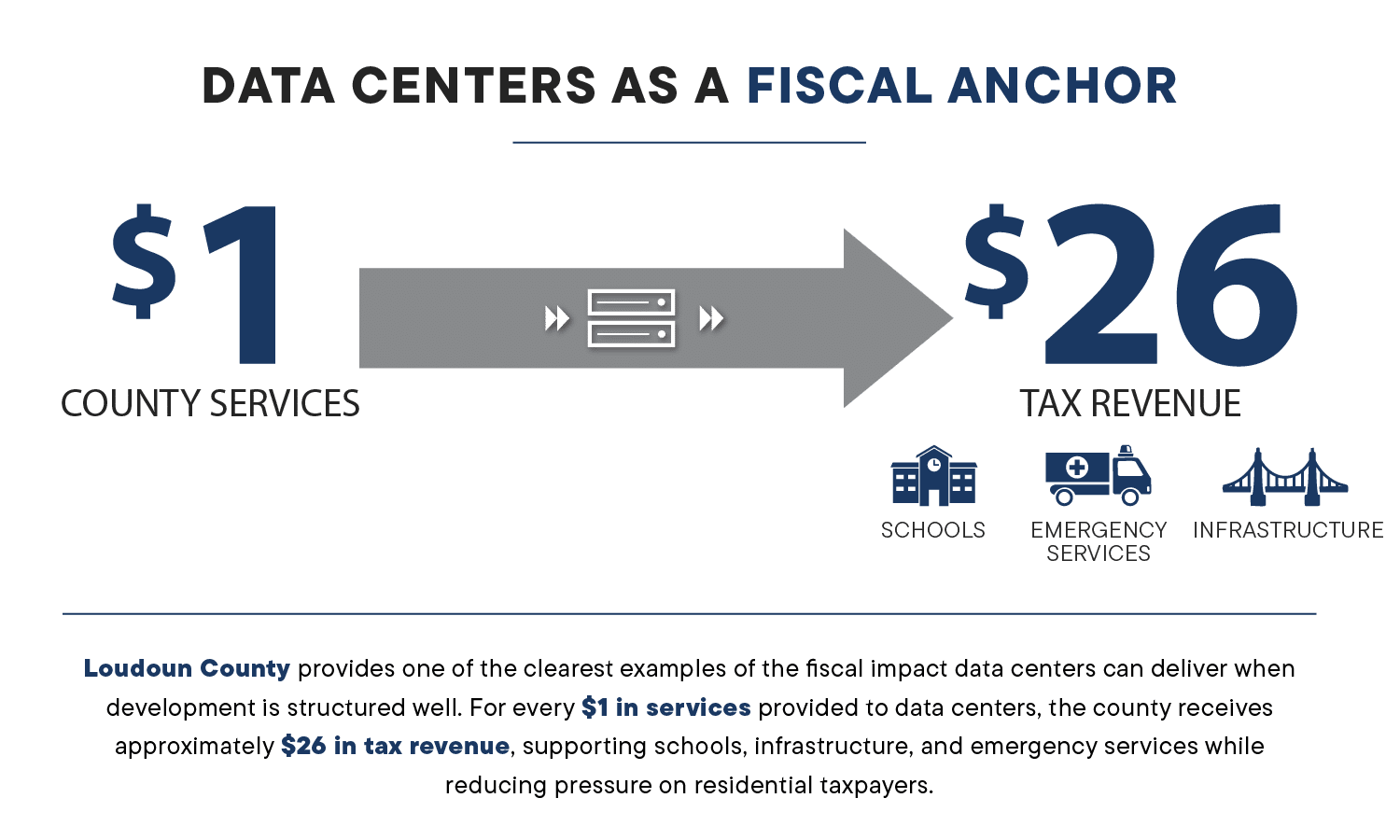
More importantly, once operational, data centers often represent exceptionally high assessed value relative to their land footprint. In many jurisdictions, that tax base can materially support schools, fire protection, libraries, roads, and other public services without creating sustained traffic, significant housing pressure, or major day-to-day service demand.
Unlike stadiums or entertainment complexes, data centers deliver fiscal benefits quietly. Their daily operational footprint is small, but their contribution to local budgets can be transformational, provided tax incentives are structured carefully and do not erode long-term value.
Jobs: Fewer, But Higher Skill and Negotiable
It is true that data centers generally do not generate the same number of permanent jobs as factories or distribution hubs. But the jobs they do create are typically technically challenging, stable, and well-paid, particularly in nonurban markets.
Facility operations, systems maintenance, controls, networking, electrical support, and security roles frequently exceed local median wages and do not always require a traditional four-year degree. With the right approach, data centers can become entry points into skilled technical careers.
Crucially, communities are not passive participants in this outcome. Local governments can require local hiring goals, apprenticeship programs, and partnerships with community colleges or trade schools as conditions of approval. When workforce provisions are negotiated upfront, data centers can contribute to long-term skills development rather than remaining isolated facilities.
Power Demand and the Grid: From Risk to Opportunity
Energy use is the most visible and politically sensitive issue surrounding data center growth. Large facilities undeniably increase electricity demand, and unmanaged growth can strain local grids. But higher demand does not automatically translate into higher residential power bills. That outcome depends on policy and design choices.
Large data center operators are often willing, and financially able, to fund substation upgrades, transmission improvements, and interconnection costs. Many also procure long-term clean energy from solar and wind sources through power purchase agreements, effectively underwriting new generation rather than drawing solely on existing supply.
When communities and regulators require projects to pay their marginal infrastructure costs and commit to clean energy additionality, data centers can help accelerate grid modernization instead of burdening it. Energy impacts, in other words, are a design and governance issue, not an inevitability.
Water Use: An Issue That Has Evolved
Water consumption has become one of the most emotionally charged objections to data center development, particularly in agricultural or drought-prone regions. Some older cooling designs do use significant volumes of water, and communities are right to scrutinize this closely.
What is often overlooked is how rapidly cooling technology is changing. Many modern data centers now rely on closed-loop or non-evaporative cooling systems that consume little to no potable water for cooling. In these designs, water use is largely limited to ordinary domestic needs.
Local governments retain the authority to require these approaches. Permits can mandate no potable water for cooling, require reclaimed or nonpotable sources, impose water-use caps, and include drought-response triggers. When these conditions are written into approvals, water risk becomes a managed variable rather than an open-ended concern.
Land Use, Traffic, and Community Character
Compared with warehouses, distribution centers, and manufacturing plants, data centers provide relatively little disruption to neighbors once construction ends. They typically generate minimal daily traffic, limited deliveries, and no customer visitation.
Concerns about appearance and noise are legitimate, but solvable. Architectural standards, setbacks, landscaping, lighting controls, and enforceable property-line noise limits are well-established planning tools. Noise mitigation specifically is a mature engineering discipline when addressed during design rather than after complaints arise.
The lesson is straightforward: Communities that specify expectations upfront tend to avoid conflict later.
The Case for Conditional Approval
The strongest defense of data center development is not blind enthusiasm, but conditional negotiation grounded in governance.
Communities that successfully host data centers typically insist on:
- Clear community benefits agreements
- Transparent reporting on energy, water, and emissions
- Project-funded grid and infrastructure upgrades
- Modern cooling and noise-control standards
- Local workforce and training commitments
These conditions shift the conversation from “trust us” to “here are the enforceable terms.” That shift often determines whether a project faces opposition or earns acceptance.
Asking the Right Question
Data centers do not belong everywhere, and they should not be approved automatically; but neither should they be dismissed as inherently negative or extractive.
The better question for communities is this: Can this project strengthen our tax base, modernize our infrastructure, protect our resources, and create pathways for residents?
In many cases, the answer is yes, if leaders use the tools already available in zoning, permitting, and development agreements. When they do, data centers can become not symbols of unwanted growth, but examples of how modern infrastructure and local stewardship can coexist.
Demand for advanced semiconductor fabrication facilities is higher than ever. Projections indicate that the semiconductor industry will reach $1-$1.1 trillion by 2030, largely fueled by the growth of artificial intelligence and data centers. To capture this growing market, it is paramount that legacy facilities modernize quickly.
Today, there are about 26 fab facilities in the U.S., 17 of which are legacy facilities, and only nine meet the requirements to be considered modern. A legacy semiconductor fab facility is one built before the widespread adoption of building information modeling. These pre‑BIM fabs often rely on outdated drawings and models that no longer reflect actual field conditions.
Over years of operation, pre-BIM fabs accumulate tool relocations, rerouted utilities, and undocumented modifications, resulting in an unreliable “source of truth” slowing modernization efforts. By creating a trusted as-built digital baseline that accurately reflects real-world conditions, legacy facilities can rectify decades of undocumented change.
The Challenges Pre-BIM Fabs Encounter When Attempting to Modernize
The facility documentation for many legacy semiconductor fabs rarely reflects real‑world conditions. Since the fab’s original construction, numerous upgrades, tool relocations, and utility reroutes have occurred without proper updates to the master models or drawings. As a result, the existing documentation is often incomplete, inconsistent, or entirely outdated.
When pre-BIM fabs, under increasing market pressure, begin planning their next wave of upgrades, they inevitably encounter critical information gaps. Without accurate, up-to-date data about what is physically installed, including updated tool locations, utility re-routes, and past modifications, teams struggle to plan schedules and design new layouts effectively. The lack of accurate as-built information also increases the likelihood of coordination friction and issues such as spatial clashes and misalignments, causing delays and costly installation rework.
Establishing a trusted, as-built baseline closes the gap between historical documentation and present-day conditions. Accurately capturing and updating the fab’s current state empowers teams to plan and execute future upgrades far more seamlessly.
What Does “Trusted” Mean in a Fab Context?
In a semiconductor fab context, the term “trusted” refers to the reliability, accuracy, and professional rigor behind the data used for planning, design, and construction. Another key component of trustworthy data is that it has been thoroughly validated by a geospatial solution expert. By contrast, “untrustworthy” data is incomplete, inconsistent, and does not reflect the current built environment, providing fabs with little, if any, value.
All fabs must work with third party vendors to scan their facilities and generate geospatial data. Unfortunately, vendors may fail to capture site information comprehensively, or they may not establish the governance needed to maintain an accurate, continuously updated baseline. When this occurs, facilities often revert to manual methods, such as tape measures and on-site guesswork, which cause erroneous measurements and error propagation. In many cases, pre-BIM fabs will accept the tolerance issues that arise from manual methods over the hassle of working with an inaccurate digital baseline.
Legacy facilities must apply careful scrutiny when selecting a partner to develop a digital baseline of their construction site. While many vendors can access the latest hardware, such as wearable cameras or off-the-shelf scanning tools, few possess the surveying discipline or fab-specific experience required to generate high-precision, actionable as-built data. A trusted provider will have deep surveying expertise and understanding of measurement accuracy, error propagation, and the downstream impact poor data has on modernization initiatives.
Establishing a Comprehensive Workflow
In addition to creating a trusted as-built baseline, pre-BIM facilities will need to have a workflow in place that covers everything from control and scanning through modeling and validation. The first step is developing a strong control network, which provides the precise reference framework for all subsequent measurements.
When the control network is robust, scan data is accurate, producing a trustworthy model, which is foundational for pre-BIM fabs to make future upgrades. A robust control network also requires the right control point density, scaled to the complexity of the environment. In practice, this means tighter spacing and a higher density of points in congested, high-precision areas where line-of-sight is limited and tolerances are tight, and wider spacing with fewer points in simpler, more open areas. Getting this density right is foundational to building a trustworthy control network, which in turn produces accurate scan data.
A strong control network, however, is just the starting point. The subsequent workflow is what makes the scanned data usable in an operational fab. Once control is established, scanning needs to be planned around real constraints such as line-of-sight, congested chases, overheard utilities, white steel, sub-fab spaces, and busy active work areas. These scans must be consistently registered back to the control network so captured point clouds from different levels (utility level, sub-fab, interstitial, fab, etc.) and time periods align without drift or errors.
From there, modeling and validation translate these scans into coordinated, decision-ready information such as utility routing, clearances, and install zones. Quality assurance and quality control then verify that the data matches field conditions and flag anything uncertain or out of tolerance. This practical, end-to-end chain is what turns scan data into a trusted baseline that teams can build and install against, supporting tool install readiness and reducing clashes before crews arrive on site.
The Importance of Governance: Prioritizing Scope When Fabs Can’t Model Everything
As legacy, pre-BIM fabs modernize, they will need to make sure their digital baselines stay current, which will require ongoing governance. Effective governance is not a one-time task but a continuous process. Even after a high-quality as-built model is established, minor changes can jeopardize its accuracy. Put simply: The model must evolve as the facility evolves.
Note that effective governance does not mean re-scanning the entire facility every time a small change occurs. For extremely large fab facilities, frequent rescanning is neither practical nor efficient. A bay containing equipment that has remained largely unchanged does not require the same level of scanning attention as an area that has undergone substantial modifications.
Fabs must identify and prioritize those areas that have experienced the most change. Then, processes can be established to regularly re-scan and update high-activity areas, especially high-density regions where tools are constantly getting installed, demoed, or relocated. This targeted form of governance will enable owners and project teams to make faster decisions, improve install readiness, and execute upgrades with greater schedule predictability, without wasting resources capturing stable areas that haven’t meaningfully changed.
Being Competitive Means Working with a Partner Who Goes the Extra Mile
The next decade of the semiconductor industry will be a critical time. Those pre-BIM fabs that modernize quickly and achieve meaningful efficiencies first will gain a strategic advantage over the competition. Conversely, those that continue to face clashes, misalignments, or unexpected field conditions during upgrades will inevitably fall behind.
To stay competitive, legacy facilities must work with a partner willing to go the extra mile; one that closes the gap between documentation and field reality, rather than simply pointing out problems. While many companies can identify where a model and reality differ, such as incorrectly sized or located openings, a truly best-in-class partner goes further.
By transforming a model so it accurately reflects real-world conditions, and by delivering a governed, decision-ready baseline that is accurate, validated, and maintained over time, a great partner enables a pre-BIM fab to pursue modernization with confidence. In the end, the goal isn’t just an updated model of the fab; it’s a direct path to faster install readiness and greater schedule certainty.