Data centers have become one of the most debated forms of infrastructure development in North America. To some communities, they represent unchecked growth: massive buildings, heavy power demand, water concerns, environmental impact, and relatively few permanent jobs. To others, they are the essential engines of the modern economy, quietly powering everything from health care and emergency services to manufacturing, education, cloud computing, and artificial intelligence.
There is some truth in both perspectives. But the debate is too often framed as a binary choice: Should we approve the building of data centers in our communities or should we reject them outright? But that is the wrong question. The real issue is not whether data centers should be built, but how they can be built so they have a positive impact on the community.
When planned and governed thoughtfully, data centers can function much like modern utility infrastructure: capital-intensive, low impact on daily life, fiscally transformative, and compatible with local priorities. When approvals are rushed, poorly conditioned, or disconnected from community expectations, they can just as easily generate frustration and backlash. The difference lies in policy and design.
Data Centers as Critical Infrastructure
The rapid expansion of cloud computing, digital services, and AI has elevated data centers from a niche real estate class to critical infrastructure. Their growth is not speculative. It is structural. These facilities now underpin health records, financial systems, logistics networks, industrial automation, education platforms, public safety systems, and more.
Seen through this lens, data centers resemble other forms of utility infrastructure. They are designed for reliability and scale, not visibility or foot traffic. Their value lies less in daily employment counts and more in systemic support for the modern economy.
That framing does not excuse poor siting or weak oversight. It does, however, suggest that communities should evaluate data centers using infrastructure criteria, including long-term fiscal impact, resource stewardship, and compatibility with local planning goals, rather than comparing them to uses such as retail or manufacturing.
The Economic Reality: High Value, Low Daily Burden
One of the most common criticisms of data centers is that they do not create enough permanent jobs once construction is complete. That observation is fair, but incomplete.
Data center projects often involve hundreds of millions, or even billions, of dollars in upfront investment. Construction generates substantial demand for site preparation, civil work, utility coordination, electrical systems, structural materials, concrete, steel, fiber, cooling equipment, and security infrastructure. For many rural and suburban communities, that phase alone can create a meaningful economic lift for regional contractors, suppliers, and skilled trades over multiple years.
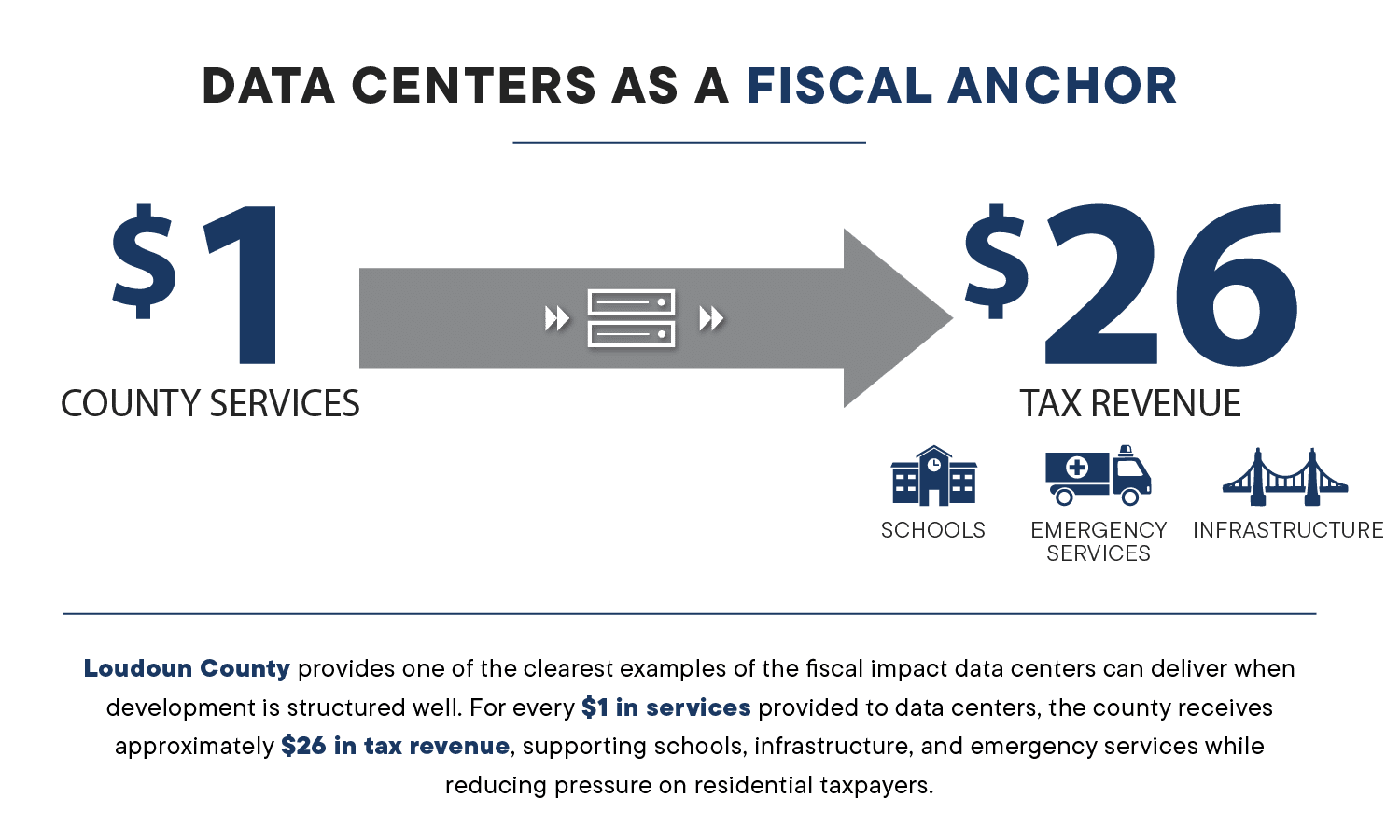
More importantly, once operational, data centers often represent exceptionally high assessed value relative to their land footprint. In many jurisdictions, that tax base can materially support schools, fire protection, libraries, roads, and other public services without creating sustained traffic, significant housing pressure, or major day-to-day service demand.
Unlike stadiums or entertainment complexes, data centers deliver fiscal benefits quietly. Their daily operational footprint is small, but their contribution to local budgets can be transformational, provided tax incentives are structured carefully and do not erode long-term value.
Jobs: Fewer, But Higher Skill and Negotiable
It is true that data centers generally do not generate the same number of permanent jobs as factories or distribution hubs. But the jobs they do create are typically technically challenging, stable, and well-paid, particularly in nonurban markets.
Facility operations, systems maintenance, controls, networking, electrical support, and security roles frequently exceed local median wages and do not always require a traditional four-year degree. With the right approach, data centers can become entry points into skilled technical careers.
Crucially, communities are not passive participants in this outcome. Local governments can require local hiring goals, apprenticeship programs, and partnerships with community colleges or trade schools as conditions of approval. When workforce provisions are negotiated upfront, data centers can contribute to long-term skills development rather than remaining isolated facilities.
Power Demand and the Grid: From Risk to Opportunity
Energy use is the most visible and politically sensitive issue surrounding data center growth. Large facilities undeniably increase electricity demand, and unmanaged growth can strain local grids. But higher demand does not automatically translate into higher residential power bills. That outcome depends on policy and design choices.
Large data center operators are often willing, and financially able, to fund substation upgrades, transmission improvements, and interconnection costs. Many also procure long-term clean energy from solar and wind sources through power purchase agreements, effectively underwriting new generation rather than drawing solely on existing supply.
When communities and regulators require projects to pay their marginal infrastructure costs and commit to clean energy additionality, data centers can help accelerate grid modernization instead of burdening it. Energy impacts, in other words, are a design and governance issue, not an inevitability.
Water Use: An Issue That Has Evolved
Water consumption has become one of the most emotionally charged objections to data center development, particularly in agricultural or drought-prone regions. Some older cooling designs do use significant volumes of water, and communities are right to scrutinize this closely.
What is often overlooked is how rapidly cooling technology is changing. Many modern data centers now rely on closed-loop or non-evaporative cooling systems that consume little to no potable water for cooling. In these designs, water use is largely limited to ordinary domestic needs.
Local governments retain the authority to require these approaches. Permits can mandate no potable water for cooling, require reclaimed or nonpotable sources, impose water-use caps, and include drought-response triggers. When these conditions are written into approvals, water risk becomes a managed variable rather than an open-ended concern.
Land Use, Traffic, and Community Character
Compared with warehouses, distribution centers, and manufacturing plants, data centers provide relatively little disruption to neighbors once construction ends. They typically generate minimal daily traffic, limited deliveries, and no customer visitation.
Concerns about appearance and noise are legitimate, but solvable. Architectural standards, setbacks, landscaping, lighting controls, and enforceable property-line noise limits are well-established planning tools. Noise mitigation specifically is a mature engineering discipline when addressed during design rather than after complaints arise.
The lesson is straightforward: Communities that specify expectations upfront tend to avoid conflict later.
The Case for Conditional Approval
The strongest defense of data center development is not blind enthusiasm, but conditional negotiation grounded in governance.
Communities that successfully host data centers typically insist on:
- Clear community benefits agreements
- Transparent reporting on energy, water, and emissions
- Project-funded grid and infrastructure upgrades
- Modern cooling and noise-control standards
- Local workforce and training commitments
These conditions shift the conversation from “trust us” to “here are the enforceable terms.” That shift often determines whether a project faces opposition or earns acceptance.
Asking the Right Question
Data centers do not belong everywhere, and they should not be approved automatically; but neither should they be dismissed as inherently negative or extractive.
The better question for communities is this: Can this project strengthen our tax base, modernize our infrastructure, protect our resources, and create pathways for residents?
In many cases, the answer is yes, if leaders use the tools already available in zoning, permitting, and development agreements. When they do, data centers can become not symbols of unwanted growth, but examples of how modern infrastructure and local stewardship can coexist.